boardspace.net


notation1


Piece Names

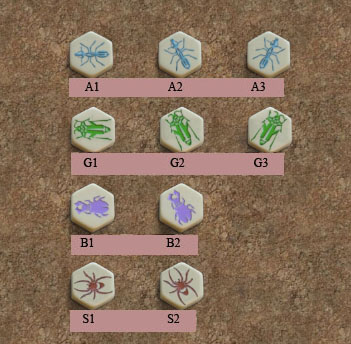
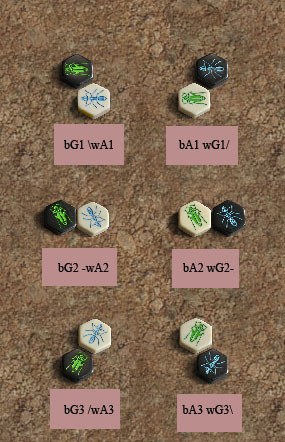
  • The pieces are designated by their English names: Queen Ant Grasshopper Beetle and Spider, and a number for those pieces which have more than one instance.
  • The number of the piece corresponds to both the order in which it was played, and its geometric orientation.  The first piece is always played oriented horizontally.  The second piece played is always oriented like a like from upper-left to lower-right, the third piece is always played oriented from upper-right to lower-left.
  • The pieces are always placed "point downward" so that any adjacent piece is clearly either left or right.

notation2

Move Names


  • The piece which moves is named first.  The place it came from is not named, it comes from where it was, either in the reserve or somewhere on the board.
  • One of the pieces which the moving piece is placed adjacent to is named second. In many cases, there several choices.  It doesn't matter which piece is used as a reference. If the moving piece is placed left of the target piece, / - or \ preceeds the piece name indicating the point of attachment.   If the moving piece is placed right of the target piece, / - or \ follows the piece name.
  • If the move is the first move of the game, or is a "beetle on top" move, no position designator is used.

Common Formations

gate formation

Gate

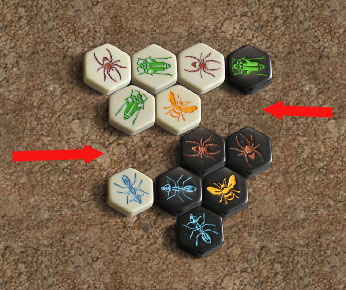
A gate formation is when two tiles are separated by  the width of one side of a tile, which is easy to recognise as two points of tiles separated by a small gap.   The gate gap is too small for any piece to slide through, including beetles.   Also, two beetles on top of the hive can form a gate which prevents other beetles from moving up or down through it.   Of course, the beetle which cannot move directly through the gate can move on top of  one of the pieces which forms the gate.

door formation

Door

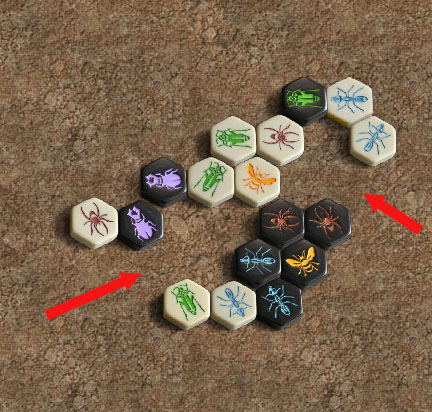
A door formation is when two tiles are separated by the width of a whole tile.   Any piece can slide through the door, but spiders gain extra mobility near a door; because when passing through a door they have three choices of direction to continue.

ring formation

Ring

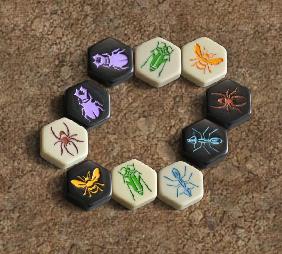
a ring formation is when pieces form a continuous circle.  Forming a ring is dangerous because all the pieces potentially become mobile, but your opponent will get the first opportunity to move one.


visitor map Site
 Map
Go to BoardSpace.net home page